
A Part of me Wanted to Die.
Earth's Enduring Cycle

"Someone told me long ago there was a calm before the storm" - Willie and Paula Nelson.
'The beautiful calm', I thought as I drove to work without a thought; this is new. For the first time, I felt tranquil. I am so calm that I don't put my foot down when the lights turn amber at the traffic lights on the whole route to work. I am so calm I haven't reacted to the screenshot just sent to me from someone I know of an online troll calling me a Kn**cker. This is nice, I thought; I feel nothing. I sat for weeks in the nothingness, wondering if my passion had taken some career break. I am sure it'll be back soon. I wondered about my anger; where was that? After months of calm, of nothing, I sat at that light before you turn onto Kevin Street, and I attempted to locate anger; I am very visual, so I can imagine my eyes searching inwardly in all the presses, under the stairs, in the junk drawer that exists inside my mind, nothing the eyes report, no anger to be found here. Then the penny drops, a frantic penny, FUCK, if you are calm, if I feel nothing, my anger is MIA, but so is my joy, then that cannot be good. I have always wanted to be less angry, but that was a different misplaced anger, which I had addressed years ago or least suppressed somehow; it rears its head from time to time. The anger I was trying so desperately to find was the anger I felt against the system, the injustices, and the fact that poor people die and no one cares, that anger I wanted to keep. I have always had a sense of the interconnectedness of society; unlike Margeret Thatcher, my core beliefs are underpinned by a sense of a 'we', and it is anger at what seeks to dismantle the 'we' that more often feels like the primary thing that pushes me forward. Maya Angelou once said, "You should be angry. You must not be bitter. Bitterness is like cancer. It eats upon the host. It doesn't do anything to the object of its displeasure. So use that anger. You write it. You paint it. You dance it. You march it. You vote it. You do everything about it. You talk it. Never stop talking about it." Where is my anger? Panic surged within me as I grappled with an emptiness that felt overwhelming. Moments later, grief flooded in—a realisation that left me feeling helpless against the vast struggles of others: friends in need, the amount of young working-class men dying, later that year the people in Palestine facing obliteration, those trapped in prison or the care system—every struggle became too immense for me to bear alone but being alone was not something I ever felt until this moment.
Greed and power are woven deeply into our systems; how naive did I feel thinking I could effect change? As these thoughts swirled around like frantic pennies dropping into a black hole inside my head, they transformed into screams—a primal release as I pounded on the steering wheel in frustration over my foolishness for believing I could make a difference in anyone's life. Suddenly, that calm shifted violently into a storm that obliterated any sense of purpose or identity I thought I had. I could no longer make meaning out of who I was or what was next. My mind began to suggest that I am now part of the theatre of politics; people think if I am there, there is hope that something might happen, and power likes that I am there so they can feel like they agree with the working class girl from time to time and that makes them feel good about their privilege. I am 'political charity'. Every day, I get in my car and drive into the houses of power, the Irish parliament and for years, I have been cheered on, congratulated and pointed to as a representative who has worked hard and been elevated by society and elevation I detest to be honest as that is not what this is, or what me being in Irish politics ever meant to me. I have a sense those more privileged in there feel safer in my presence than I want them to be because they can point to me and say, "I hear what Lynn is saying" They agree and nod their heads and tip-toe around their classism so they can be seen to champion the girl from Killinarden but never, ever implement her ideas. Being close to me is enough for them to have ticked the 'class' box'. I wondered if my presence makes them too comfortable. Being there is their limp act of 'solidarity', not the restructuring of society that I stand for.
In a flash, I moved from calm to storm, and the storm destroyed my purpose and instantly deconstructed my identity. The anger I lost was there in a sense. Still, it was pointed directly at me for thinking I could improve the living conditions of communities like mine, letting in the thought that I couldn't. It was one of the saddest realisations I ever had. Many of us can relate to the sense of loss of purpose and its emotional impact. I watched a cooking show recently, which I hate, but on the menu was a deconstructed dish; at that moment, I felt like a deconstructed salad, and floating around in the debris of my life's storm were all the parts of me, one of those parts being the part that feels like it knows it is over, and in the words of Queen, "Goodbye, everybody, I've got to go, gotta leave you all behind and face the truth". The truth is at that moment I felt had no purpose, and I cried and never stopped, grappling with the idea that nothing matters and everything fucking matters and this is just another moment of growth, one I hoped would last just one spin around the Celtic calendar. Transition from winter in 2023 was non-starter, I was on a calendar, within a calendar inside the Celtic calendar.
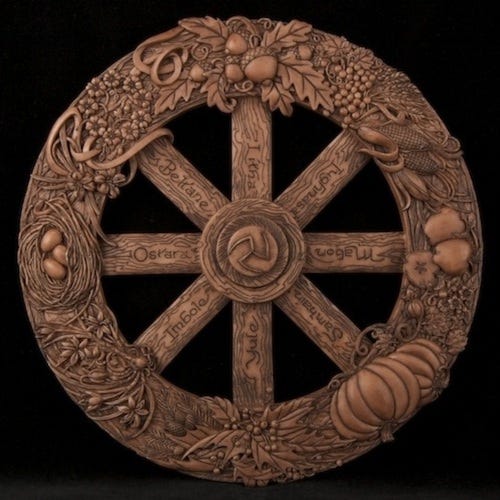
Metaphysics comes from the Greek meta ta physika ("after nature") and refers to concepts beyond human perception. It involves studying areas that objective material studies cannot reach. I have spent many hours deciphering whether my thoughts are metaphysical or physical. If they are metaphysical, then they are not tangible. If they are not tangible, then I must not make them so by ending my life because ending my life brings my thoughts into an action that has a very real impact. There was no sign that I was moving toward such deep thoughts about my life or identity. The fears that I couldn't change society in any shape or form were just one part of a larger picture of deep introspection, self-discovery and shedding of the rubbish I picked up along the way.
Thoughts can feel so painful sometimes it isn't easy to put them in a metaphysical category. "I must not die", I repeated endlessly in my head. I was being existential, which would be very on brand, or I had some metaphysical collapse that I didn't need to bring into reality: yet still, the voice persisted, well my voice, the one that talks to me all day long, and the fact that it's the same voice that tells me to go to work, put on my knickers, feed the dogs, boil the kettle, and now it's telling me my life is coming to an end is reason enough to try not to take it seriously. I have had an internal narrator as far back as I can remember.
I first remember this voice being strong as young as three. I was in town, and my Da was with my brother and me. We were standing on what I think was O'Connell Street Bridge, and the voice kept saying, 'Jump, Lynn, climb up and jump.' I didn't have a death wish; I just had a companion in my brain that endlessly suggested mad stuff to me. I still get it on bridges and train platforms, and it doesn't always tell me to jump. Sometimes, it tells me weird stuff, like going over and tickle that man, which would be random and funny. I then visually imagine doing such a thing. The idea is absurd enough to make me giggle, and I go about my day. Only this time, the voice was a little quieter and more sure of itself, and it was now accompanied by pictures of how I should die. This couldn't be what it is. Not now, hardly; I am as close to the safe middle as ever. Why would the middle be the end?
There is a line from my autobiography, and I am paraphrasing, that says I don't live in the middle of experiences and that I am a woman of extremes. At that time, I wanted a centre, and the centre was safe. I see the centre as a place where I could drop my shoulders, roll my head back in relief and bask in the middle of, well, the middle of me. The middling is the spectrum of experiences and conflicts within me, not the middle of a week or a life; there is nothing chronological about the middle. Suppose you take a scalpel to me and carefully slice down the metaphysical core of my being, which is impossible, I know, because of the, you know, not being tangible. Will there be a centre where all other metaphysical things gravitate around, giving rise to understanding all the non-material realities of my life? This compulsive search in me to understand life, myself, and its purpose has persisted since the beginning of me. I am curious, like all day long curious. Only now, a part of me wants to die. I have to keep requesting that curiosity to stand down, for contemplation to take a back seat, and for reason to take over the driving of the death train.
A part of me pondered mortality without experiencing panic or crisis, and it is unclear if I was feeling depression or despair. In the early months of 2023, I was engaged in activities that I found fulfilling. Since that February, Grace Dyas and I have been working on what I consider significant work – Theatre of the Oppressed in Mountjoy Prison. This project explores the social justice theatre methodology created by Augusto Boal and the Arena Theatre in Brazil in the 1970s. Theatre of the Oppressed aims to create scenes or performances that prompt discussions about issues a community faces, seeking collective solutions. The power of the collectiveness of this work with the men was also forcing me to face myself. Augusto Boal, its creator, eventually became a Senator and used this methodology to scrutinise legislation actively with colleagues and stakeholders. He referred to it as "a rehearsal for reality. " Unbeknownst to myself, I was in full rehearsal of my reality. That same year, the film I wrote was gearing up to go into production with a whole ensemble of working-class talent. I had lots to be excited about, yet I couldn't avoid this gnawing suggestion that something was about to end; I was nearing the end.
For many months, I kept these feelings to myself. My relationship was ending, which would ultimately be a good thing. Yet, we were still together, afraid or unwilling to let go, forced to let go by summertime when I revealed the depths of anxiety I was feeling about my life. From April onwards, my mind was pretty quiet; the ADHD meds I started that year demanded that the thoughts in my head form an orderly queue instead of rolling around entangled in my head like a frenzied anaconda breeding ball. That's where the tears came from; they replaced the thoughts. There was so much crying my friend suggested I take a daily Dioralyte for fear I'd fall to the ground with dehydration. Tears are not metaphysical, although some spiritual traditions symbolise them. It was all so confusing.
I began to engage with my voice.
Me: "Why do you want to die?"
Also, me: "I don't. I think I have lived my life, I have reached the end of my experiences, and all that's left to experience is death."
Notice I mentioned I started ADHD meds, but we won't go there today as I was yet to even register this new diagnosis with the terms of the thoughts that part of me wanted to end. I will insist that only 'a part' of me wanted the end cause so many other parts did not entertain this deep extensional hole I had fallen into. I wasn't getting the answers I needed from myself at that moment. However, one idea that resonated with me was that I shouldn't be afraid to engage with the idea that maybe the death of another kind was plaguing me: identity, ego, psychological. I never fully realised that much of my life was spent pleasing people and needing validation. I often wondered if I only held certain beliefs or worked to help others in return for the label of 'good person'. I have experienced many intrusive thoughts throughout my life, with one of the most consistent being, "You are only helping because you want others to believe you are not a bad person." While my parents pals never gave me this idea, I have started to understand the impact of living with undiagnosed ADHD on my self-perception and authenticity. I had a new frame in which to look at my life, but for that frame to become more transparent, I had to get into the depths of my mind with a shame and guilt I didn't know I had and have a dialogue. We always tell people there is light at the end of the tunnel, but first, I needed to be brave and stand there in the dark and not force the light in before I understood the dark. Whatever was there, at times, it felt dark; it was at its darkest when accompanied by compulsions to go deep into the forest alone. Deep down, I was frightened that I would feel nothingness forever, and if I am sincere, I genuinely felt I was at the end of my life cycle; it felt incredibly natural to me that now was the time to die.
Out Loud.
I knew it was time to talk my thoughts out loud, but words and language often don't fully describe what is inside us. Wittgenstein said language can be confusing due to its inherent ambiguity. People use language differently and apply different meanings. Consequently, this creates limitations in language use; therefore, we must recognise instances where a speaker's intended meaning may be unclear or open to misinterpretation. A lot of which is happening in this writing. You may have noticed I have yet to use the term suicide or suicide ideation; I am being unclear, which is purposeful as I wasn't convinced that is what was happening; instead, I chose to say to a 'friend' that my mind feels dark right now. I remember feeling that it hadn't felt so dark since I was twenty years old, and even then, I didn't have a part of me that wanted to die. In his philosophical essay The Myth of Sisyphus, one of my favourite philosophers, Albert Camus, wrote the famous line, "There is, but one truly serious philosophical problem and that is suicide ." What I subjectively understand him to be provoking is that meaning in one's life is what we understand as a life worth living to be: purpose. Camus, however, takes on this idea and compares the meaning that exists in life and the meaning that exists in death, and neither is any different. So if it is purpose and meaning that you can't live without, then death is no use either cause you won't find it there. I consider it a challenge to engage with meaning differently than seek it in death. I had to find the language that would put someone on alert, someone I thought would mind me, without me going full nuclear, so I told them I had been crying for months, and my mind was dark, and for me, that passed the Wittgenstein test. The tears started randomly: an old couple on a park bench, a person without a home sitting in a doorway, a song, thoughts of my Da, thoughts of never being loved the way he loved me, someone's heart being broken in a film and people I am sure cry at this stuff all the time. Still, moments triggered the tears, and then they fell without reason daily from April to December, like an endless well, the timeline of pregnancy only at the end. There was no baby; instead, a more authentic version of me.
Unfortunately, while initial support came from one person in my life, it evaporated two days later. The worst part was that the tears became deeper because they were no longer ancient; I was feeling very real abandonment during what was potentially a period of, I am going to say, suicide ideation. I retreated from these feelings and what felt like abandonment, no, cruelty, in fact, and I wished I could press rewind and keep the words from ever crossing my lips; it would be some time before I told anyone else, and I am glad I did because everyone else wrapped me in love and care.
My only problem was that I was telling people where I was, but I always told them with a level of control so they wouldn't worry too much; yes, a part of me wanted to die, but I wasn't going to, so I tried very hard not to catastrophise.
Revealing Oneself.
In the whispers of the storm were many messages, and through navigating the edges of my existence, I found the voice that told me I was terrible, powerless, and purposeless. We re-negotiated our terms, entered a new memorandum of understanding, and in big black ink, our new contract said, "All is forgiven."
My heart is still raw, and so much is left to understand. For the past two years, I've been on the brink of discovering something significant about myself, and parts of me have changed rather than ended. They have become bolder and more unapologetic. I am clinging a lot less tightly to the messages society has told me for decades. I am even more sure now than ever that individualism will destroy us and that I am not meant to be in the centre of anything. I am meant to be uncomfortable because my role is to challenge, and that is uncomfortable. I am an uncomfortable woman, and instead of pushing that away, I am now pulling it in.
I've always searched for answers in many ways, but the questions change whenever I find the answers I seek. By October 2023, I found myself frustrated after six months of tears, wondering when they would stop and why I had chosen the wrong people to confide in. Anger began to seep in (a good thing), and it compelled me to venture out into the forest to understand why it was calling to me. October 19th, the day before my thirty-ninth birthday, was the most challenging day I have ever faced regarding emotional reckoning. Yet, it was also a day of illumination. At this point, I was doing my best to negotiate with the emptiness that lay beneath the weight of my tears, pleading for the impulsive thoughts of not "wanting to be here" to go away. I believe I cried for nearly six months, releasing old tears tied to a different time—tears that belonged to an older version of myself.
The newfound stillness I experienced while on ADHD medication allowed these emotions and new thoughts to break through whatever dam had kept them under control. Perhaps some part of me needed to die, and those impulsive thoughts about death and endings were not physical but emotional. It was in an emotional transition, possibly signifying the end of a narrative I had clung to about myself. I sat at my laptop, frustrated that I was still crying and struggling to appreciate my time at the Tyrone Guthrie Centre, where I had spent the week writing. Surrounded by the woods, I left the workspace and wandered among the trees, barely able to see through the tears that clouded my vision. Suddenly, my body stopped, and as if compelled to do so, I began to speak to the trees. It felt intensely necessary. I howled at them desperately, begging them not to reject or turn away from me and listen without judgment, accusation, fear, or questions. "Please save me," I repeated through heaves and whimpers.
Exhausted, I finally reached the end of the hole inside me and felt a profound sense of being heard. I screamed at one tree, expressing my distress, saying I wanted to die, and it didn't call an ambulance. There was a recognition between us, a deep understanding that the only thing that truly mattered at that moment was the existence of this tree. I was able to voice my pain, and the tree absorbed it. Many philosophers sought to explain the origins of human knowledge or how we perceive knowledge. They often attempted to place things of substance and matter as a centre of knowledge, i.e. inputs from the material world; others, Descartes for example, Plato and Hegel for that matter, believed in the pursuit of knowledge through philosophy and, in essence, believed that knowledge or truth can only be trusted if the mind, or you, arrives at it on its own.
I don't know if I arrived at the truth on my own that day—maybe personal truths, not truths about the world—but where I arrived was that as long as trees exist, I don't need to die. Interconnectedness and connection were reignited, but not in human form. Still, all roads (or trees) lead back to what it means to be alive. This tree listened; it didn't waver, project its feelings onto me, run away, treat me strangely, or panic. That tree understood me, and in that moment, I understood myself.
The brink is where something significant, good or bad, is about to happen. We are always teetering on its edge in some way. Isn't existence itself a brink? Now that I have moved away from that edge, I am curious about what it all means. Most importantly, what emerged from the turmoil is a more radical version of myself. Through the storm, I discovered a part of me that profoundly contemplates emancipation and realises my purpose is tied to the collective struggle for freedom and fairness.
Meanwhile, the part of me that once wanted to die was like a seed beginning to blossom into a question: How do we re-configure the world? Hence, it is safe for everyone. How do you do it while never becoming complacent? In pursuing this endeavour, I had to let go of the parts of me that were weighing me down and the people, too. I don't want to be part of a world of 'I'; I want to be surrounded by people who work as a 'we', and for that to happen in its whole form, I contemplated my own life and purpose, unwillingly in the beginning, necessarily in the end, to free myself from being a commodity of politics and individualism. On the other side of the part that wanted to die was a bigger and more potent version of me that grew in solidarity with the world and towards a radical self-acceptance of the self. Self-acceptance is never some fixed point in time or meaning but is ever-evolving and ever-living alongside the collective and never before or instead of it.
Wow, a beautiful piece of writing. I resonated deeply with this Lynn. Thank you for sharing it 💜
That hit home Lynn. An example of 'we' . I was on the luas and the young lad beside me was on the phone. He was recounting his intention to get clean. When he finished the call, i wished him well in his recovery and we chatted about his circumstances. I asked if he had heard of you , he hadnt but whipped up google and exclaimed on reading the intro, shes one of our own . He passed me the phone and asked what two words meant, underprivileged and deprivation...